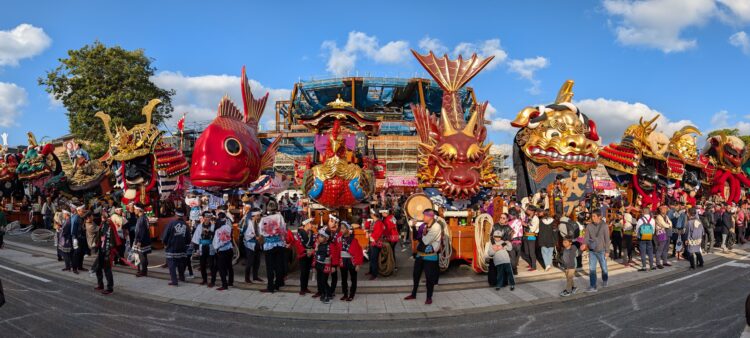
The Karatsu Kunchi Festival in early November is sensory overload in the best possible way, where centuries of tradition meet an infectious, high-energy atmosphere. The festival’s 14 lacquered floats, each over 150 years old, glide through the streets like living works of art, pulled by teams in striking traditional outfits that add to the spectacle. All around, the buzz of the crowd mixes with the sizzle of street food stalls, offering everything from local delicacies to classic festival bites. Yes, it’s crowded, but that only amplifies the excitement, making you feel fully immersed in something deeply rooted and wildly alive. It’s the kind of cultural experience that stays with you long after, and one that absolutely shouldn’t be missed.

Taking a selfie at Sakurai Futamigaura, a famous Shinto Shrine located in the north of Itoshima city

Sakurai Futamigaura’s "Couple Stones" are two sacred, connected rock formations symbolizing a happy marriage

Flowers growing along the Itoshima Peninsula

Becky at the Beach Cafe Sunset's driftwood gazebo in Itoshima

Taking the train from the Fukuyoshi Station to Karatsu for the start of the 3 day Karatsu Festival

A chaotic scene at the Karatsu train station as visitors arrive for the first day of the Karatsu Festival

Signs for the last train back from Karatsu after the festival!

Crane sculpture outside the Karatsu Train Station

Sculpture of "Children's statue whistling" located in front of Karatsu Station

Chocolate covered banana treats for sale at the Karatsu Festival

A participant during the opening ceremonies of the Karatsu festival holding a bottle of sake

Children in one of the Karatsu festival floats

Attendees of the Karatsu Festival flock to the main street leading to the historic Karatsu Shrine in search of street food and drink

Vendor selling "tornado potato", a popular Japanese snack that is a whole potato spiral-cut and fried on a skewer

Becky smiles with a soju lemonade drink and crispy denkushi (fried Japanese chicken skin skewer)

Japanese girls posing with a Karatsu Festival mascot on the opening night of the 3 day festival

A street food vendor preparing takoyaki (round dumplings containing diced octopus, tempura scraps, pickled ginger, and green onion)

Karatsu Kunchi is an autumn festival that takes place annually over 3 days from November 2 to 4 in Karatsu City

Opening ceremonies of the Karatsu Kunchi festival where massive, intricately carved floats are hauled through the streets of Karatsu

The 14 hikiyama (parade floats) used in the Karatsu Kunchi festival are over 100 to 200 years old, constructed between 1819 and 1876

The neighborhood teams pulling the floats were traditionally men but there were quite a few children volunteering to be part of the 3 day Karatsu Festival

A team leader marches in front of his float as the performers make their way through the streets of Karatsu

The 14 massive hikiyama floats of the Karatsu Kunchi festival are pulled by teams of locals known as "hikiko", representing the 14 traditional neighborhoods of Karatsu City

Dressed in matching traditional happi coats, pants, hachimaki headbands, and straw sandals, these teams (totaling about 4000 people) pull the 2 to 5 ton floats through the streets while shouting "En-ya! En-ya!"

The energy and enthusiasm of the spectators motivated the float pullers

The "hikiko" (teams of neighborhood locals that pull their respective floats) were organized from the smallest in the front to the strongest in the rear. When the floats gained momentum, these children had to sprint down the street to avoid getting run over!

Three girls helping to pull their neighborhood's float. Check out their matching "happi" coats

Pulling "Minamoto Yoshitsune no Kabuto" (the helmut of Minamoto Yoshitsune), a float built in 1844

The floats are made using "ikkanbari" (layers of lacquer over papier-mâché). They are up to 23 feet tall and weigh up to 5 tons!

End of day 1's festivities as the crowd falls behind the last float in the parade

Getting ready for day 2 of the Karatsu Kunchi Festival. All the hikiyama (floats) are staged in a massive parking lot and arranged in the order of the parade

Karatsu Kunchi is a famous Shinto festival designed to give thanks for a good rice harvest

Karatsu Kunchi has been designated as a UNESCO Intangible Cultural Heritage event

Two children wearing traditional festival attire wait for the morning parade to kick off on day 2 of the Karatsu Kunchi Festival

Japanese kids posing for a photo at the Karatsu Kunchi Festival

This boy's important job will be to ring the bell during the Karatsu Kunchi Festival

"Tai" (sea bream) float at the Karatsu Kunchi Festival. This float was created in 1845

Flutists on the "Kinjishi" (Golden Lion) float. This float was created in 1847

The 14 floats of Karatsu Kunchi are shaped like lions, samurai helmets, fish and turtles

Children waiting for kickoff of day 2's festivities

Karatsu Kunchi's Hououmaru (phoenix) float was constructed in 1846

Shichihomaru float was constructed in 1876

The "Aoijishi" (Blue Lion) float was created in 1824

"Kame to Urashima Taro" (The Turtle and Urashima Taro) float was created in 1841

Using momentum to keep the sea bream float in motion

Two men stand on top of the float to whip the crown into a frenzy at the Karatsu Kunchi Festival

"Minamoto Yoshitsune no Kabuto" (Minamoto Yoshitsune's Helmet) float, circa 1844

A float named "Uesugi Kenshin's Helmet"

Karatsu Kunchi traces its history to the late 17th century, during the Kanbun era of the Edo period (1603–1867). The word "kunchi" translates to "a day of offerings". The Karatsu festival is an offering of thanks to the Shinto gods for a bountiful harvest

"Otabisho Shinko" is the highlight of day 2. All the floats are pulled across Nishinohama Beach. Because each one weighs up to 5 tons, the teams struggle to move them in the soft sand

A spectator carries his dog to the Karatsu Kunchi Festival

Delicious pan fried dumplings

Stall selling "Ayu no Shioyaki" (salt-grilled sweetfish), a popular Japanese street food featuring whole fish skewered and grilled over charcoal

Day 2 of Karatsu Kunchi lasts all day! Here, the tired "hikiko" (pullers), dressed in traditional Edo-period firefighter outfits, pull the float back to their respective neighborhoods

Girls collecting donations to maintain the floats. Each neighborhood spends vast sums of money to maintain these incredible works of art